
🎲
Daily Sixes
A fresh 4-player Ludo round every 24 hours. Round-robin all week, winner is whoever lands the most outright wins. The default format for most friend groups.
A private bracket with the six people who actually show up on group chat. Seven formats from Daily Sixes to a knock-out 1v1. Six-letter codes for everyone abroad, Bluetooth for everyone in the same room. No entry fees, no winnings, no gambling — only the league chat afterwards.
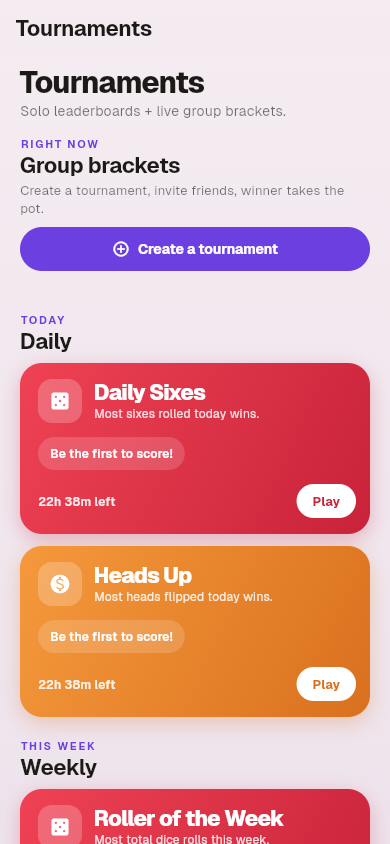
Each format is a bracket and a leaderboard rolled together. Friends join with a 6-letter code, the bracket auto-fills, and the leaderboard updates after every round.
A fresh 4-player Ludo round every 24 hours. Round-robin all week, winner is whoever lands the most outright wins. The default format for most friend groups.
1v1 single-elimination Ludo bracket. 4, 8, or 16 players. Two pawns each instead of four — rounds finish in 8-10 minutes so a 16-player bracket wraps in an evening.
A dice-roller-driven leaderboard. Best total over 100 rolls per week. Light, low-commitment, and great for keeping a chat group warm between proper Ludo nights.
Highest score in three Flap-style runs. Brutal but fast — most people are out in 60 seconds. The arcade tournament that the office group chat keeps coming back to.
Doodle-style infinite climber. Highest altitude wins the day. Two attempts per player. Excellent for cousins who claim "Ludo is too slow".
Classic Snake on a daily leaderboard. One run, no retries. The format with the largest spread between casual and obsessed — people get genuinely competitive.
2048 weekly bracket. Highest tile reached wins. Slow burn, longer rounds, but the prestige of the friend group goes to whoever reaches 4096 first.
The most common feedback in testing was that people expected the tournament flow to be complicated. It isn't.
The bracket auto-locks when it fills. If it doesn't fill within 24 hours, the host can either start with whoever joined or extend the window. No participation, no awkward bench-warming — the format adapts to the count.
Six cousins in three cities — Lahore, Karachi, Toronto. They used to play Ludo on group video calls but lost track of scores and arguments about whose pawn got captured kept derailing the call. The fix in their group chat:
Three weeks in, the cousins added a parents-vs-kids version. Same format, same code-sharing, different leaderboard. The "Ludo league at home" is now a fixed Friday ritual for two households on opposite sides of the planet. More multiplayer setup tips ❯
Most "Ludo tournament" apps drop you into a public lobby with strangers, real-money entry fees, and an aggressive matchmaking algorithm that pairs new players with sharks. The competition is intense but the social texture is gone — you don't know who you beat, and you don't carry the result anywhere.
A private bracket flips that. The six people in your friend group all enter the same code, all play the same format, and the result lives in shared memory. The cousin who won the Ludo league last week gets ribbed in the family WhatsApp for an entire weekend. That ribbing is the actual product. The bracket is just the machine that produces it.
Game Night's tournament module is built for that second model. We deliberately don't offer public lobbies or real-money stakes. Every bracket is private by code, every leaderboard belongs to one group of friends or family, and the only currency is the screenshot people share afterwards.
Two real Ludo tournament apps. The trade-off is gambling versus bragging rights.
| Feature | Game Night | MPL Ludo | Pocket Ludo |
|---|---|---|---|
| Free, no entry fees | Yes | Real-money entry | Real-money entry |
| Real-money prizes (gambling) | No (by design) | Yes | Yes |
| Private friend brackets | Yes | Public lobbies only | Limited |
| No signup, no KYC | Yes | KYC + phone | KYC + phone |
| Tournament formats | 7 | 3-4 | 2 |
| Offline (Bluetooth / LAN) brackets | Yes | Online only | Online only |
| Restricted in Indian states (Telangana, Andhra etc.) | No restrictions | Yes | Yes |
| 13+ chat gate (COPPA-safe) | Yes | Adults only (gambling) | Adults only |
MPL and Pocket Ludo are real-money skill platforms; if you want to play Ludo for cash, they're built for it. Game Night is what you install when you want a private bracket with your cousins and no one's paying to enter.
No. There are no entry fees, no winnings, no in-app currency, no real-money stakes anywhere. By design, so we stay open in jurisdictions like Telangana and Andhra Pradesh where rummy and Ludo cash apps are blocked.
Open Tournaments, tap Create, pick a format, share the 6-letter code on WhatsApp. Friends paste the code to join. The bracket fills automatically and locks when full.
Seven — Daily Sixes, Heads Up, Roller of the Week, Flap-Off, Climber's Cup, Snake Charmer, and Tile Master. The first three are Ludo and dice-based; the last four are arcade tournaments.
Up to 32 in one bracket, though most friend groups settle on 4-8. Larger brackets take longer to fill and longer to finish.
Online brackets do; same-room brackets use Bluetooth or Wi-Fi LAN and need no data. The multiplayer guide covers each transport mode in detail.
Free on Google Play. Seven tournament formats, private codes, no entry fees, no gambling. The Ludo tournament app for friend groups, not crypto traders.
GET IT ONGoogle Play