🎨
Four colours, four homes
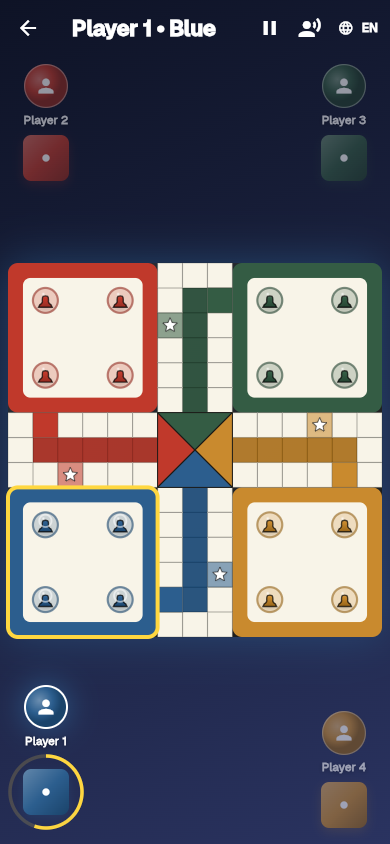
Red, green, blue, yellow. Each player gets four pawns starting in their home base and races them along the cross-shaped track to the centre column.
Four colours. Sixteen pawns. Safe squares, sixes to release, doubles roll again. Play solo against AI, pass the phone around the dinner table, or invite your cousin in Karachi with a six-letter code. No coins to buy, no daily bonus to chase, no signup.
Ludo isn't one game; it's a family of rules that descend from Pachisi. We respect the differences instead of picking sides.
Red, green, blue, yellow. Each player gets four pawns starting in their home base and races them along the cross-shaped track to the centre column.
Marked with a star. While your pawn sits on one, an opponent landing there can't capture it. The classic Pachisi safe-square rule, faithfully implemented.
You need to roll a six to release a pawn from home. Some families allow other numbers too — we expose that as a toggle in the rules menu.
Roll a six, take another turn. Three sixes in a row forfeits the round — the original rule most commercial Ludo apps quietly removed. We kept it (and made it optional).
Land on an opponent's unsafe pawn and they go all the way back to start. Capture bonus extra-turn is on by default — toggle it off for a gentler family round.
Many traditional Pachisi rulesets require exact rolls to enter the centre column. Optional in our setup screen, off by default for newcomers.
Same board, four ways to get pawns moving with the people you actually want to play with.
One phone. Hand it around. The classic sitting-on-the-floor experience, with no internet and no second device. How it works ❯
Phones discover each other through Google Nearby. No router, no signup, no mobile data — just two thumbs and a six.
Same Wi-Fi network, fastest mode. Scan a QR to join. Great for family rooms and offices with patchy cellular.
Host creates a room, shares a code over WhatsApp or iMessage, friends paste it in. No account, no friends list to maintain.
Full multiplayer walkthrough, latency tips, and host requirements live on the multiplayer page.
The board you grew up with has cousins on five continents. They all trace back to one game.
Pachisi (پچیسی) is the original South Asian race board, attested in Indian courts as far back as the 6th century CE and depicted in murals at Fatehpur Sikri where Emperor Akbar reportedly played on a marble courtyard with palace servants as living pawns. The Hindi word pachis means twenty-five, the highest score on the traditional cowrie-shell throw.
Spanish settlers brought a derivative back to Iberia as Parchís, which then spread into Latin America. The American version Parcheesi was trademarked in the US in the 1860s and remains a staple board-game brand. The British simplified the rules into Ludo (Latin for "I play") in 1896 and patented it — the version most of Pakistan, India, the UAE, and the rest of the Commonwealth still plays today.
Korea has its own cousin in Yut Nori, played with four flat-stick dice, especially around the lunar new year. Iran's Pachis is functionally identical to ours. Once you've played the Game Night board, every other regional name will feel like home.
The rule that the British modernised most was the dice. The original Pachisi used six cowrie shells, scored by how many landed mouth-up — a deeply unequal distribution that rewarded patience over speed. The 1896 Ludo patent swapped them for a single fair six-sided cube, which is what makes the modern game faster and arguably more chaotic. Game Night lets you nudge it back the other way: turn on the optional two-dice variant and the game shifts toward the strategic, blocker-heavy pace of traditional Parchís.
Sources: Britannica entry on Pachisi (2024 revision); Wikipedia's Pachisi and Ludo (board game) articles; H.J.R. Murray, "A History of Board Games Other Than Chess" (Oxford, 1952). We linked the references from the research blog.
Parents who want one tap to start, kids who want a real board. Pass-and-play on a single phone keeps everyone in the same room.
Bluetooth and pass-and-play work in airplane mode and during power cuts. Two phones, one board, zero internet required.
The 6-letter online code drops into a WhatsApp message. They paste, you both see the same board within seconds.
All four below are real, popular Android Ludo apps. We've installed each. Here's where Game Night actually wins and where it doesn't.
| Feature | Game Night | Ludo King | Parchisi STAR | Ludo Star |
|---|---|---|---|---|
| Free, no paywall | Yes | Yes (ads) | Yes (ads) | Yes (ads) |
| No signup or phone number | Yes | Required online | Account needed | Phone signup |
| Bluetooth play (no internet) | Yes | No | No | No |
| Wi-Fi LAN play | Yes | No | No | No |
| Pass-and-play on one phone | Yes | Yes | Yes | Limited |
| Configurable rules (sixes, dice, timer) | Yes | Fixed | Some | Fixed |
| No coins or in-app currency | Yes | Coins | Coins | Coins |
| Non-personalised ads (COPPA-safe) | Yes | Targeted | Targeted | Targeted |
| 18 other games in the same app | Yes | No | No | No |
Ludo King with over a billion installs is the category leader — its global tournaments are something we don't try to replace. Game Night is what you install when you want the board, not the casino. If you've been searching for a Ludo King alternative, this is it.
Yes. Every board, rule, and multiplayer mode is free. Occasional interstitial ads run between games, never during a roll. We don't sell coins, dice skins, or "lucky packs".
Yes. Pass-and-play and Bluetooth modes work in airplane mode. Only the 6-letter online code needs data. Great for flights, long car rides, and load-shedding evenings.
Up to 4. Any combination of humans and AI. The board always shows all four colours — empty colours are AI-controlled.
Same game, three eras. Pachisi is the ancient Indian original. Parchís/Parcheesi is the Spanish/American descendant. Ludo is the 19th-century British simplification. Our board lets you toggle classic Pachisi rules on or off.
No. Ads only run on round-completion screens, never during a roll or move animation. Toggle is in Settings. Ads are non-personalised so they meet child-directed policies.
Install Game Night free on Google Play. No card, no account, no nonsense — just a real Ludo board for the people you actually want to play with.
GET IT ONGoogle Play